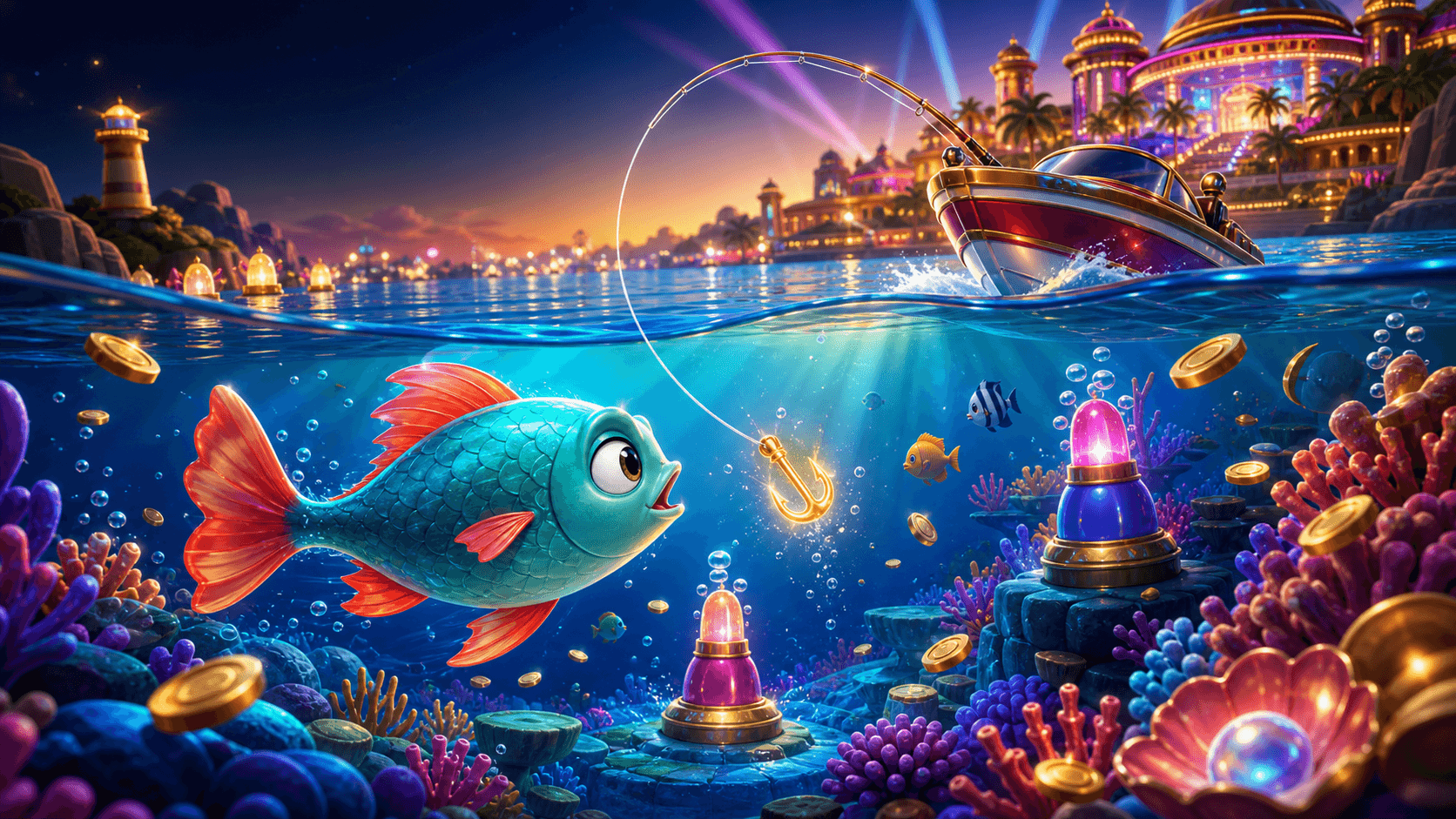
Fishing Derby
Cast placement, live steering, and a line-tension skill loop in a jewel-bright casino lagoon.
The casino becomes the game
Valeer is a browser-native 3D gaming property built around skillful arcade worlds, fair human competition, familiar tables, and one connected Grand design spanning eligible paid games.
The first playable trio
Our first vertical slices establish the final visual bar while proving three different game systems. The builds are private, play-credit only, and available to invited founding testers.
Cast placement, live steering, and a line-tension skill loop in a jewel-bright casino lagoon.

A polished six-deck table with familiar rules and LUX, a virtual presentation host.

True virtual strips, staged reel stops, one published math profile, and one shared illustrative jackpot pulse.
One engine · four expressions
Practice, solo, head-to-head, and tournament play reuse the same controls, physics, score, and random environment. Only the settlement contract changes.
Read the water, choose a lure, place the cast, manage line tension, and steer a living catch through submerged hazards. Every fish has a published solo value; every competitive lake turns the same system into a trophy race.
Marquee tournament concept
A long-form survival traversal with the emotional cadence of a bracketed poker event. The field begins together, spreads across a living world, and creates its bracket through proximity duels rather than a static tournament tree.
A complete property
The platform is not a collection of unrelated games. Every surface inherits a shared identity, wallet boundary, integrity model, jackpot language, and path into a future physical arena.
Fixed, published performance bands. The game reacts to the player’s inputs, never their account history.
Human-funded pots, transparent commission, ranked matchmaking, and placement curves that reward the middle.
Long-form survival events where proximity encounters generate the bracket as the field converges.
Blackjack, baccarat, roulette, craps, and poker remain conventional, legible, and secondary to the arcade.
Eligible paid-game designs reserve one independent stake-scaled Grand determination without changing their native mechanics.
The same games migrate into haptic reels, driving pods, large-format displays, live brackets, and finals.
Connected Grand design
Each eligible paid round receives one fixed-odds determination; stake scales the modeled award, not the hit probability. Native bonuses keep their own mechanics and cannot reroll the result.
The complete game constellation
The portfolio is now a machine-readable build contract. Every game names its skill, chance, feature, modes, delivery state, and required math disclosure before production art begins.
Theme without math drift
A skin can change illustration, lighting, host wardrobe, ambience, music, particles, and cabinet form. It cannot change the accepted outcome, paytable, reel strip, prize curve, or competition rules.
Midnight velvet, gold heraldry, tournament crowds, heroic brass.
Cyan water light, coral-magenta wildlife, glass percussion.
Indigo space, prismatic treasure, synthetic choir, orbital machinery.
Saturated warm color, bright percussion, kinetic feature ribbons.
Moonlit silver, blue fire, quiet bells, and aurora effects.
The system behind the spectacle
The alpha proves game feel with non-purchasable, non-redeemable credits. Regulated value stays unavailable until every custody, eligibility, control, and independent-approval gate is real.
One account, eligibility, preferences, and access state.
Play-credit now; custody, ledger, and reconciliation before cash.
Versioned rules, committed randomness, replay, and one settlement.
Comparable conditions, funded pools, matchmaking, and brackets.
Limits, session time, cool-off, exclusion, history, and help.
Risk, support, finance, compliance, incidents, and rollback.
The repeatable delivery system
Each game moves through the same gates. Visual ambition comes after the controls, math, replay, and settlement contract have already proven themselves.
Game thesis, skill loop, chance envelope, modes, score, settlement, and abuse cases.
Deterministic graybox, math simulation, input replay, and performance-band validation.
Browser-native 3D vertical slice, art direction, sound, motion, and tactile feedback.
Authoritative multiplayer, ranked pools, tournament orchestration, and integrity systems.
Independent testing, jurisdiction packages, release gates, observability, and controlled rollout.